

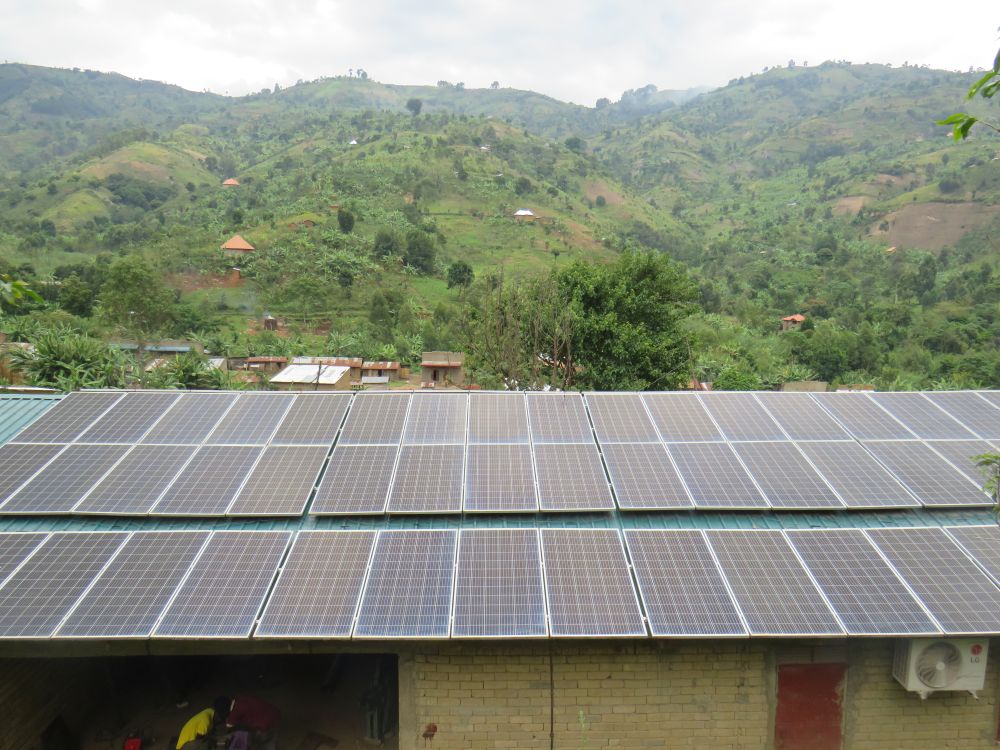
For decades, residents of remote villages in Buhuhira and Bwesumbu Kasese District lived without electricity, relying on candles, torches and long journeys to access even the simplest services. Today, a pilot electrification project implemented by KIIMA Foods in partnership with Smart Villages Research Group and supported by Innovate UK is beginning to change that reality.
Using Single Wire Earth Return (SWER) technology — a low-cost system that distributes electricity through a single overhead wire while the earth serves as the return path — the project has brought reliable electricity to households in Buhuhira and Bwesumbu sub-counties. Though still in its pilot phase, the initiative is already creating significant social and economic change in the communities it serves.
Brighter Homes, Better Education
For Kabugho Janet, a 40-year-old farmer in Buhuhira Sub-county, the arrival of electricity has transformed her children’s education.
Before the connection, her children studied using a torch, and the family spent about UGX 16,000 on lighting every month. As a small-scale farmer, she says the cost was difficult to sustain.
Now her home is connected to reliable electricity.
“My children can now revise their books easily and the power rarely goes off,” Janet says. “Their performance in school has greatly improved.”
The project has also reduced household costs while providing safer lighting. Torchlights and candles — previously common study tools — often posed risks to children’s eyesight and increased the likelihood of fire accidents.
New Opportunities for Rural Businesses
Beyond homes, access to electricity is creating new economic opportunities in the villages.
Bwambale Joshua, a resident of Kuruhe village in Bwesumbu Sub-county, says daily life has become significantly easier since electricity arrived.
Previously, he walked nearly 10 kilometres to another trading centre just to photocopy documents such as his national ID. His children studied using candlelight, exposing them to fire hazards and eye strain.
Today, electricity has enabled several businesses to emerge within the community. Welding workshops now fabricate doors and windows locally, salons operate in the trading centre, and residents can access computer services such as printing and photocopying.
Joshua says the project has also dramatically reduced his lighting costs — from about UGX 20,000 to around UGX 3,000 for servicing.
“My children can now watch television and study comfortably,” he says. “Services that we used to travel long distances for are now available here.”
Strengthening Local Agriculture
Electricity is also supporting agricultural productivity, the backbone of the local economy.
The project is anchored around Smart Agri-Business Centres established by KIIMA Foods, which generate power through mini-grids producing about 45 kilowatts. These centres provide cold storage facilities that allow farmers to preserve agricultural products for longer periods, reducing post-harvest losses.
With reliable power, farmers can also process crops such as cassava into flour using electric milling machines — adding value to their produce and increasing incomes.
How the Technology Works
According to Bwambale Edgar, a technical officer with KIIMA Foods, the project relies on SWER technology, a system designed to deliver electricity to rural communities at a lower cost.
“Single Wire Earth Return uses a single overhead wire to transmit electricity from the power source to the community,” Edgar explains. “Instead of using multiple wires like conventional electricity lines, the system uses the earth as the return path for the current.”
The electricity is generated at Smart Agri-Business Centres, mini-grids established by KIIMA Foods that produce about 45 kilowatts of solar power. From there, power is transmitted through a single conductor — sometimes as small as a 2-millimetre cable — to households within the community.
To complete the circuit, an earth rod is inserted into the ground at the household connection point. The earth acts as the return pathway for the electrical current back to the nearby ground system.
“This method reduces the number of poles, wires and infrastructure needed compared to conventional electricity distribution,” Edgar says. “That makes it a much more affordable solution for rural electrification.”
So far, the project has connected six households in Buhuhira and six in Mbata-Bwesumbu within a radius of about 500 metres from the Smart Agri-Business Centres.
Powering Agriculture and Local Services
The electricity is also strengthening the local agricultural economy.
The Smart Agri-Business Centres include cold storage facilities that allow farmers to preserve agricultural produce for longer periods, reducing post-harvest losses.
Electric power is also enabling machines used to process agricultural products such as cassava into flour, helping farmers add value to their produce and increase incomes.
KIIMA Foods has also organized a cooperative of 220 farmers to support collective marketing and strengthen agricultural livelihoods in the area.
Community-Wide Change
Local leaders say the project has brought a sense of progress to communities that previously felt forgotten.
Richard Syalya, LC1 Chairman of Kuruhe Village, recalls a time when residents travelled long distances simply to charge their phones.
“Our children were growing up without even knowing what electricity looks like,” he says. “Now people can charge phones, run machines and access computer services within the village.”
The increased lighting in homes and trading centres has also improved security and extended productive hours in the evenings.Looking Ahead
So far, 12 households — six in Buhuhira and six in Bwesumbu — have been connected within a 500-metre radius of the Smart Agri-Business Centres. While the initial target was to reach 70 households, regulatory limitations and technical challenges have slowed expansion.
Even so, community members and project implementers say the early results demonstrate the potential of SWER technology to bridge the rural electrification gap.
For Janet and many others, the impact is already clear.
“We never believed electricity could reach such a hard-to-reach area,” she says. “Now it has changed our lives.”