

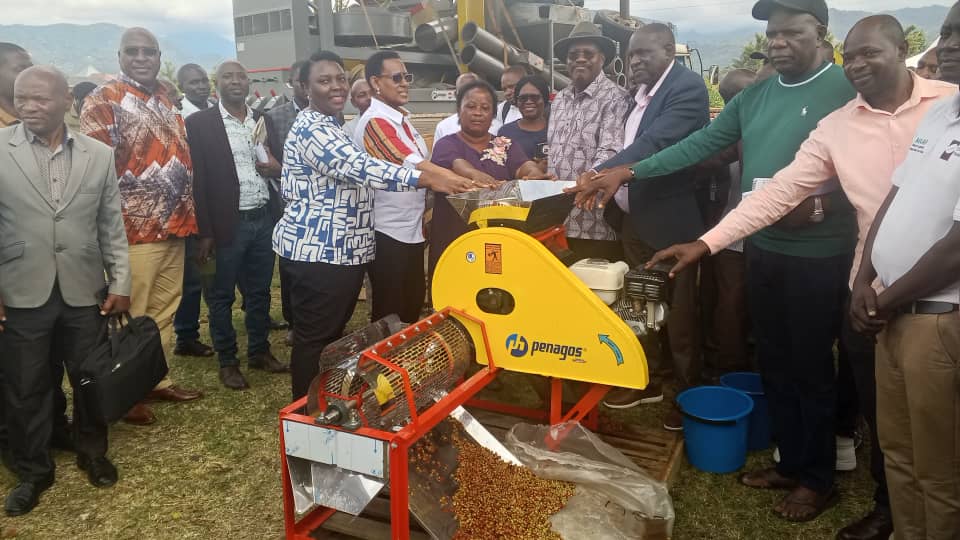
The Ministry of Agriculture, Animal Industry and Fisheries has delivered essential coffee processing equipment to farmer groups and cooperatives across Kasese District. This targeted initiative aims to enhance agricultural quality, minimize post-harvest losses, and drive value addition within the regional coffee supply chain.
The machinery, which includes combined coffee hullers, wet mills, and motorized pulpers, was officially handed over to beneficiaries on 6th June 2026 at the Multipurpose Hall in Kasese Town. This strategic distribution is designed to transition smallholder farmers away from selling unprocessed red cherries and green beans, allowing them to engage directly with local processing and specialty markets.
With ecological conditions defined by rich volcanic soils, reliable rainfall, and altitudes stretching up to 1,800 meters above sea level, Kasese is uniquely positioned for premium Arabica and Robusta production. Currently, over 70 percent of households in the district depend on coffee farming for their livelihood, making the crop a major driver for local education, healthcare, and community economic resilience.
During the handover ceremony, the Permanent Secretary of the Ministry of Agriculture, Animal Industry and Fisheries, Major General David Kasura-Kyomukama, emphasized the economic necessity of quality control and processing.
“We are urging our coffee farmers to utilize this equipment effectively to improve the grade and quality of the coffee they bring to the market. By moving away from selling raw agricultural commodities and investing in local value addition, our farming households can secure better prices, raise their household incomes, and actively contribute to the socio-economic transformation of the country.”
The Chairperson of Kasese District, Mr. Eliphaz Muhindi Bukombi, welcomed the development but noted that rural infrastructure challenges could limit the full operational capacity of the machinery.
“We acknowledge this timely support from the central government, which directly addresses the issues of low productivity and high post-harvest losses in our sub-counties. However, the operational effectiveness of these machines will be significantly hindered by the lack of reliable electricity in several rural areas, particularly in the mountainous parts of Busongora County” . He appealed to the central government to expeditiously extend power supply to these production zones so that our farmers can fully utilize this equipment.
The event also highlighted the innovative intersection between agriculture and regional tourism, aiming to establish unique cultural branding for the district. The Permanent Secretary of the Ministry of Tourism, Wildlife and Antiquities, Ms. Doreen Katusiime, urged local stakeholders to leverage the district’s exceptional geographic branding.
“Kasese produces some of the finest coffee in the country, and it is time we formally integrate this crop into our tourism sector. We need to add coffee to our local tourism menu. By promoting traditional coffee processing practices, organizing cupping festivals, and creating farm-to-cup experiences, we can attract both domestic and international tourists, thereby opening new streams of income for our communities.”
The equipment distribution targeted several agricultural cooperatives and individual micro-stations across key sub-counties, including Bugoye, Maliba, Bwera, Kinyamaseka, Kasese Municipality, and Lake Katwe.
Among the primary beneficiaries, Isuule Coffee Farmers Cooperative Society received a combined coffee huller, Busongora Joint Organic Coffee Cooperative was allocated a wet mill, and Bukonzo Organic Cooperative received five motorized pulpers to serve its network of micro-stations, including Kaghorwe, Kithangetsa, and Kasokero. Pulpers were also distributed to individual progressive farmers and local groups, such as the Nyakeya Rural Women Group and the Bugoye Coffee Farmers Group.
Beneficiaries, including local farmers Mr. Philimon Muhuba and Mr. Richard Mbaju from Kilembe Sub-county, expressed appreciation for the machinery. They noted that access to proper hulling and pulping options would prevent them from relying entirely on middlemen who traditionally buy raw cherries at low prices.
The district leadership and technical teams from the Ministry of Agriculture are scheduled to provide ongoing capacity building, technical guidance, and additional post-harvest materials, such as tarpaulins, to ensure the sustainable maintenance and optimal use of the newly deployed assets.
The end.